Tuike and Tuska listen without rushing – reading pets inspire children to read
At libraries in Vantaa, children can practise reading to a rather unusual listener: a reading pet. A reading pet is a dog or cat that takes part in the activity together with its volunteer owner. Children can read to the animal at their own pace without worrying about making mistakes. At the same time, the activity gives volunteers a meaningful way to support children’s literacy together with their own pet.
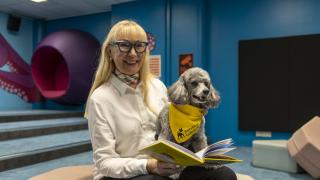
Tuija Tammi and her dog Tuike have been holding reading sessions for several years.
Tuija Tammi and her dog Tuike have been holding reading sessions for several years, first at a school and later at libraries. Sanna Kyröläinen has been visiting libraries with reading cat Tuska for about a year. Before that, they visited events and a care home for older people.
Why read to a reading pet?
For many children, reading aloud can feel intimidating. With a reading pet, the pressure eases because the animal listens patiently and does not care whether the child reads quickly or slowly.
The owners of both reading dogs and reading cats have seen how the presence of an animal affects children. Most arrive at the reading session excited, and any initial nervousness usually disappears quickly.
Tuija Tammi, the owner of reading dog Tuike, sums up the importance of a reading pet well: “A reading dog doesn’t judge or comment on how you read. Everyone can read in their own way.”
Sanna Kyröläinen, the owner of reading cat Tuska, also emphasises the accepting atmosphere. “You can come to a reading pet even if you can’t read yet. You can practise telling a story aloud using pictures, for example.”
With a reading pet, children can focus on reading without pressure to perform. This helps many of them relax and become more interested in books. When children realise that they can do it, they gain confidence and positive experiences of reading.
Reading pet activities offer a meaningful way to volunteer
Both Tuija Tammi and Sanna Kyröläinen became involved in reading pet activities because they wanted to do something good together with their pets.
Tammi was preparing to retire from her job as a headteacher when teachers at the school suggested a new role for her dog. The idea felt natural, as she had already thought that calm and sociable Tuike would be well suited to the task.
Kyröläinen, in turn, was motivated by a desire to offer an alternative to children for whom reading dogs are not suitable for one reason or another. Not everyone is able to interact with dogs, for example because of fear, allergies or cultural background. This is why different kinds of reading pets are needed.
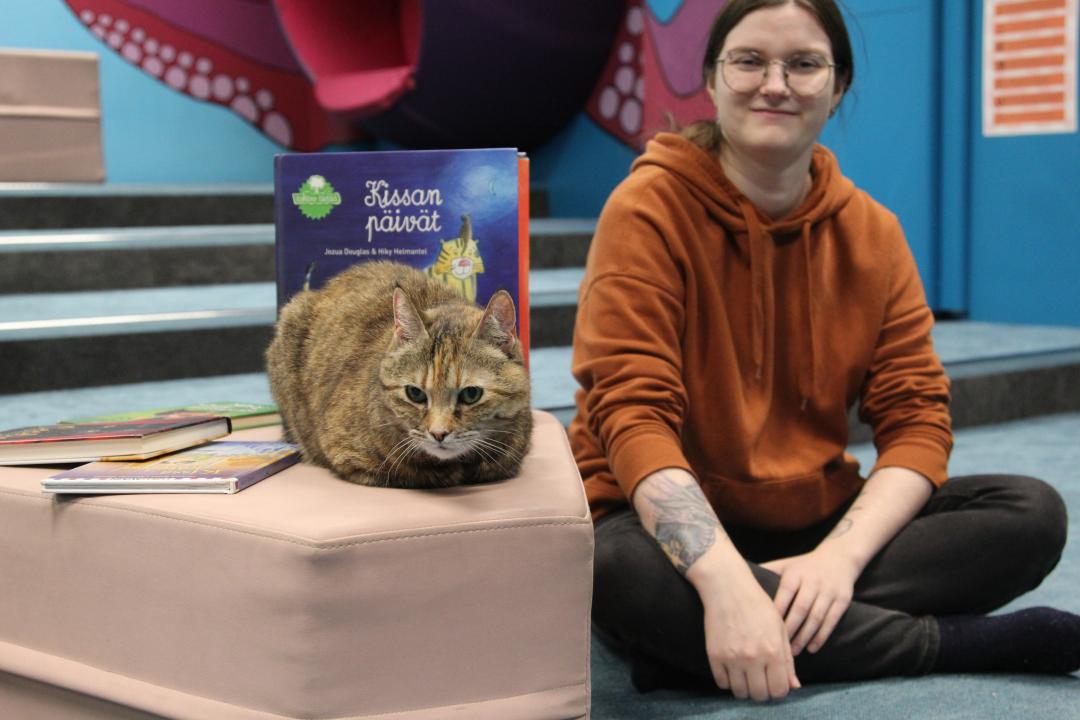
Sanna Kyröläinen has been visiting libraries with reading cat Tuska for about a year.
What kind of pet is suitable for the role?
The most important qualities for a reading pet are calmness, sociability and good behaviour. The animal must enjoy being around people and be able to behave safely even in unfamiliar situations.
Tammi also stresses the owner’s responsibility: “The handler must be able to trust their reading dog one hundred per cent.”
Kyröläinen encourages pet owners to give it a try: “Not every animal needs to become a reading pet, but many pets may have excellent qualities for the role.”
How do you prepare for the role?
Reading dog activities include training and an assessment of the dog’s suitability. Tuija Tammi attended the Finnish Kennel Club’s reading dog course, where participants learned about the practical aspects of the activity and the dogs’ suitability for the role was assessed.
Kyröläinen recommends taking things one step at a time. “There is no specific training for reading cats, but you can learn about different visiting and reading pet activities through Karvakaveri, for example.”
The first step can be very small: a visit to an event, a care home or a family you know. This allows both the animal and its owner to become more comfortable and confident.
What do volunteers get from the experience?
Both Tammi and Kyröläinen describe the activity as highly rewarding. The children’s joy and enthusiasm are the greatest reward for the volunteers. They enjoy seeing children gain the courage to read, relax in the company of an animal or discover a new interest in books.
Tammi says the volunteer work feels very meaningful. “It’s wonderful to be able to do your part in supporting children’s literacy.”
Kyröläinen highlights the joy of these encounters: “Children’s excitement around the pet easily rubs off on the volunteer too. At its best, it creates a positive cycle where everyone involved gets to experience a sense of achievement.”
How can you get involved?
Anyone interested in volunteering can contact their local library directly. A registration form and more information about volunteering at libraries are also available at helmet.fi/vapaaehtoiseksi.
What happens during a reading session?
Reading sessions are booked in advance through the library and usually last around 15 minutes. Children can bring their own book or choose something to read from the books provided by the library.
At the beginning of the session, the child has time to get to know the pet in a calm setting before settling down to read. Children can read at their own pace and pet the animal while reading if they wish. The pet’s owner remains present throughout the session.
The aim of the session is not to assess the child’s reading skills, but to provide a safe and positive experience that combines reading with spending time with an animal. Reading pets are fluent listeners in every language.
You can read to a reading pet at these libraries
- Hakunila Library: reading dog Lumo and reading cat Tuska
- Lumo Library: reading dog Martta
- Länsimäki Library: reading dog Alma and reading cat Charlie
- Martinlaakso Library: reading dogs Aliina and Lucky
- Mosaiikki Library: reading dog Daisy
- Myyrmäki Library: reading dog Noppa
- Tikkurila Library: reading dog Tuike and reading cat Tuska
Schedules are available on each library’s own page at helmet.fi/kirjastot.


