Vantaa Light Rail makes use of deadwood and forest floor material as nature and construction are reconciled
Construction inevitably changes the environment, but biodiversity can be supported in many ways, even in major infrastructure projects. At the Vantaa Light Rail construction site on Rivieranraitti, taking nature into account is reflected, for example, in leaving deadwood in the area’s natural environment and restoring the forest floor after construction.
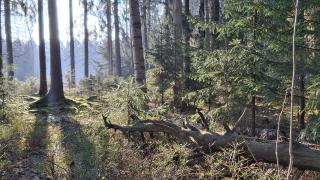
Lahopuu ja metsänpohja ovat tärkeitä elinympäristöjä. Kuva: Sara Korkeamäki
In Vaarala, a new street connection is being built for the Vantaa Light Rail between Tilustie and Fazerintie. The light rail will run through a nature-oriented environment and a new residential area.
Although trees have to be felled due to the construction of the Vantaa Light Rail, vegetation is not removed any more than is necessary for construction. Efforts are being made to support biodiversity by leaving deadwood in the area, providing habitats for various communities of plants, fungi and animals. As wood decays, pieces of rotting wood break off and mix with the litter and soil on the ground surface.
Although the trunks or branches left on the ground may puzzle people moving through the area and may look untidy to those unfamiliar with the matter, they play an important role in nature.
“By preserving deadwood, we give nature the opportunity to provide food and shelter for diverse animal and plant communities, thereby helping to prevent the impoverishment of nature,” says Sari Rinne, green construction specialist working on the project.
The scarcity of deadwood in forests is currently the most significant problem contributing to the impoverishment of biodiversity in Finnish nature. Species dependent on deadwood form the most threatened single group of organisms in Finland (Kaupunkien lahopuuopas: Lahopuun vaaliminen rakennetuilla viheralueilla. Viherympäristöliiton julkaisu nro 69. Ellington Printing Oy 2020).
The forest floor will be restored to the edges of the light rail corridor
Taking nature into account is not limited to deadwood. During construction, forest floor material and topsoil are collected from the area and later reused in the project as a recycled growing medium along the edges of the light rail corridor—where the tracks meet the forest.
The forest floor is home to many organisms, such as microfauna, bacteria and mycorrhiza, which together form an important network for nature. When the same living growing medium is returned to the area after construction, nature’s vitality is better preserved than when using manufactured growing media, which develop slowly into living substrates.
Collecting, storing and recycling the area’s own soil material also has other benefits.
“If we use a manufactured growing medium, the site usually needs to be maintained. But when we return to the area what was there before, nature takes care of it on its own ,” Rinne says.
The environment is already taken into account at the planning stage
Reconciling construction and biodiversity often gives rise to discussion.
In the Vantaa Light Rail project, as in many large infrastructure projects, the environment is already taken into account at the planning stage. Designers consider solutions that make it possible both to build new public transport and to safeguard the area’s natural values.
Before felling, the trees to be removed are reviewed in cooperation with the client, the landscape designer and the party responsible for environmental construction. The review assesses the potential use of the trees as deadwood. Trees to be preserved as deadwood are marked in the terrain according to whether they will be left directly in forest areas or temporarily stored for later placement.
“We aim not to remove unnecessarily from nature what belongs there. So let us accept nature close to the light rail, which in a way represents an entirely new kind of urban nature construction. I think that in this alliance model, alongside the tripartite cooperation between the client, builders and designers, there is also a fourth member: nature,” Rinne describes.
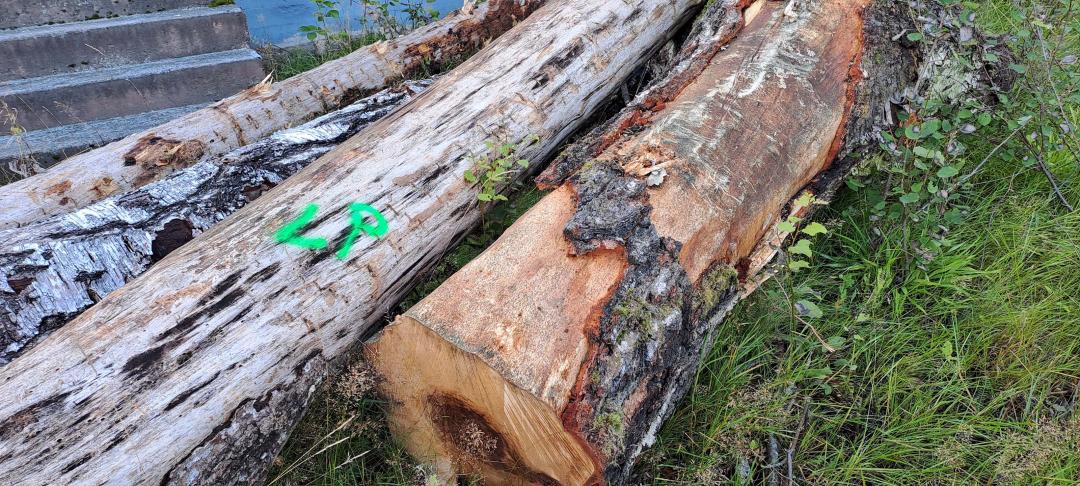
Use of deadwood in the Vantaa Light Rail project
The light rail project uses two types of deadwood
- Deadwood that, after felling, is left directly in the forest areas located within and bordering the project area.
-
Deadwood that is temporarily stored after felling and placed in the street area during surface works at the locations indicated in the street environment drawings.
Most of the deadwood in the Vantaa Light Rail project is used as decaying logs lying on the ground. Other possible uses include deadwood blocks and standing deadwood, either as snags or topped trunks. Branches and twigs can be used to build brushwood fences.


