Forests are more than individual trees - Vantaa Light Rail compensates for the harm caused by construction to nature
In the spring, the Vantaa Light Rail announced that it would use an app developed by the city to monitor the number of individual street trees cut down along the light rail route. In this way, an equivalent number of new trees can be planted as close as possible to the place where the cut trees grew.
The application will only be used to monitor the street trees along the light rail route. By March 2026, the figure for the project was slightly less than a thousand, excluding forest areas.
As a rule, the aim is to plant the replacement individual trees back where they are removed, i.e. in the street area along the light rail. For other trees planting sites are sought where there is a need and opportunity for them to grow. At the moment, it seems that most of the individual trees will be planted along the light rail in accordance with the goals.
Forest areas are taken into account more extensively
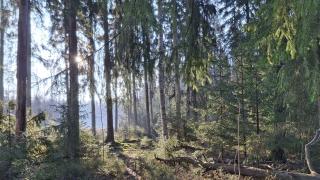
Forest areas are taken into account more extensively as entire natural and built environment habitat types. One example are the forested habitats of Kuussillanniitty, and they have been mapped separately.
All habitat types have been mapped using natural value hectares, which means that compensating for these adverse impacts on biodiversity takes into account more than just individual trees.
Nature value hectares are used, for example, in ecological compensation under the Nature Conservation Act. The determination of natural value hectares and the calculation of harm and compensation have been defined as expert work based on science.
The survey has been carried out in accordance with the principles of ecological compensation, even though the project only carried out official ecological compensation on the plot of the Vaarala depot.
The number of hectares lost is known for the light rail project, as the areas were mapped last summer.
Potential compensation locations are currently being sought. The selection of compensation areas will also be carried out in ecologically and in places that are sensible from the point of view of the state of nature. Nature reserves are not eligible as compensation areas.
The "artificial" addition of decaying wood is one of the most significant restoration measures. Cut tree trunks have already been left along Länsimäentie, for example.
New meadows increase biodiversity in urban areas
There will also be many new built environment habitats along the light rail, such as new meadows, which will create new kinds of habitats for species. In the planning of the street environment, more detailed meadow planning is carried out.
In the selection of plant species, the aim is to carefully consider pollinators, butterflies and other insects in order to support their habitats. Cooperation has been carried out with the Environment Centre of Vantaa and nature specialists, among others.
Steps towards a nature-positive Vantaa
Vantaa aims to be nature-positive by 2030, which is an ambitious goal. All the compensation work that is now being done, both the official ecological compensation under the Nature Conservation Act and the unofficial compensation for nature damage, prepare the city for nature positivity. The light rail is one of the pilots in this.
Development work includes experimentation and the creation of new practices, and the work does not happen in an instant. We do our best and strive to carry out the work as well as possible from an ecological point of view.
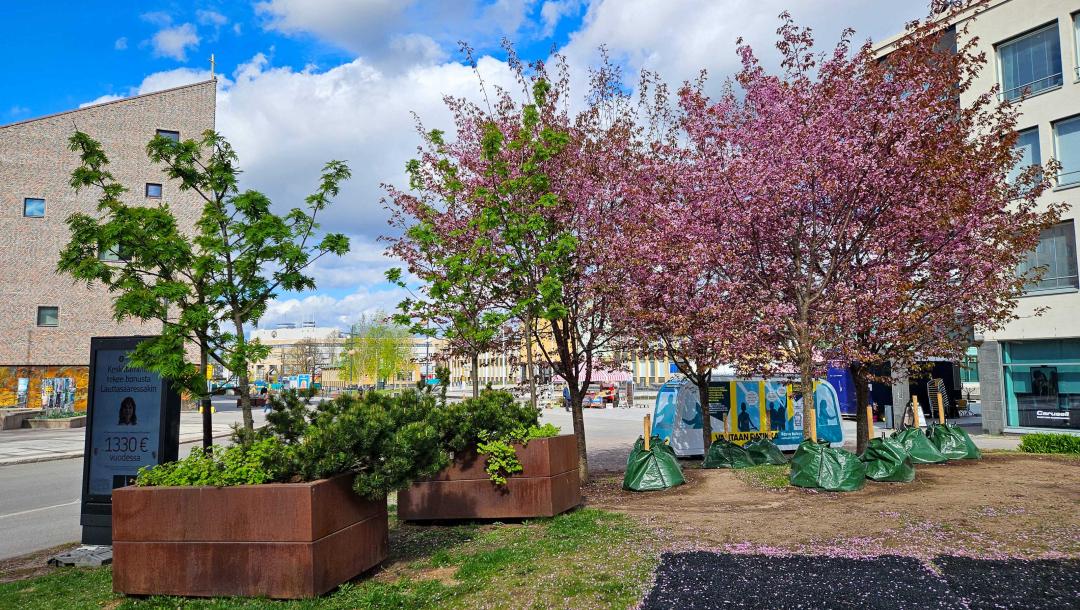
Everyone in Tikkurila can witness one successful, small experiment. In December 2025, the builders of the Library Park moved four cherry trees from the park to a new location next to Tikkurilantori. The operation carried out in the winter was a success, and the cherry trees bloomed magnificently in early May.