Rare Structural Jacking Operation Beneath Dixi: The Building Was Used as a Counterweight
An exceptional construction phase is currently underway beneath Dixi. The load of the Dixi building is being transferred to new piles to make way for the future concrete tunnel. The work uses a jacking method in which the building’s own weight is used to secure the new structures.
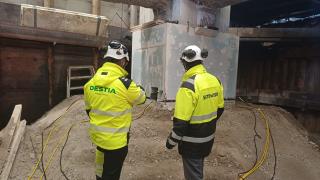
Experts from Destia and Sitowise preparing for the upcoming jacking operation
The concrete tunnel will be located beneath Tikkurila station, the local bus terminal, Ratakuja and Kirjastopuisto. At Dixi, we are constructing load-transfer structures that create the space required for the tunnel at the building’s foundation level. In practice, this means building load-transfer beams on top of new piles, allowing the existing piles to be removed from the path of the concrete tunnel.
When the project communications team first heard about the jacking works beneath Dixi, the immediate image was that the building itself was being lifted. In reality, the opposite was true: the key objective was to keep Dixi precisely in place, with accuracy measured in fractions of a millimetre. In practice, Dixi was used as a counterweight to ensure that the new piles achieved a sufficiently firm bearing against the bedrock. At the same time, part of the building’s load was transferred onto the new piles.
Load Transfer in a Large Building Is a Highly Precise Process
To create space for the concrete tunnel, we are transferring the building’s load onto new piles. The process begins with the installation of new drilled piles at suitable locations. Beneath Dixi, the drilled piles were installed to a depth of approximately 15 metres. The depth was determined so that, in the final configuration, the tops of the piles will remain approximately two metres below the future excavation level, embedded in the bedrock.
When the load is eventually transferred onto the new piles and beams, settlement simply cannot occur. The purpose of the jacking operation is to ensure that the drilled piles achieve firm bearing against the bedrock and that the building’s load is transferred onto the new piles. At the same time, the jacking operation serves as a proof load test for the new piles.
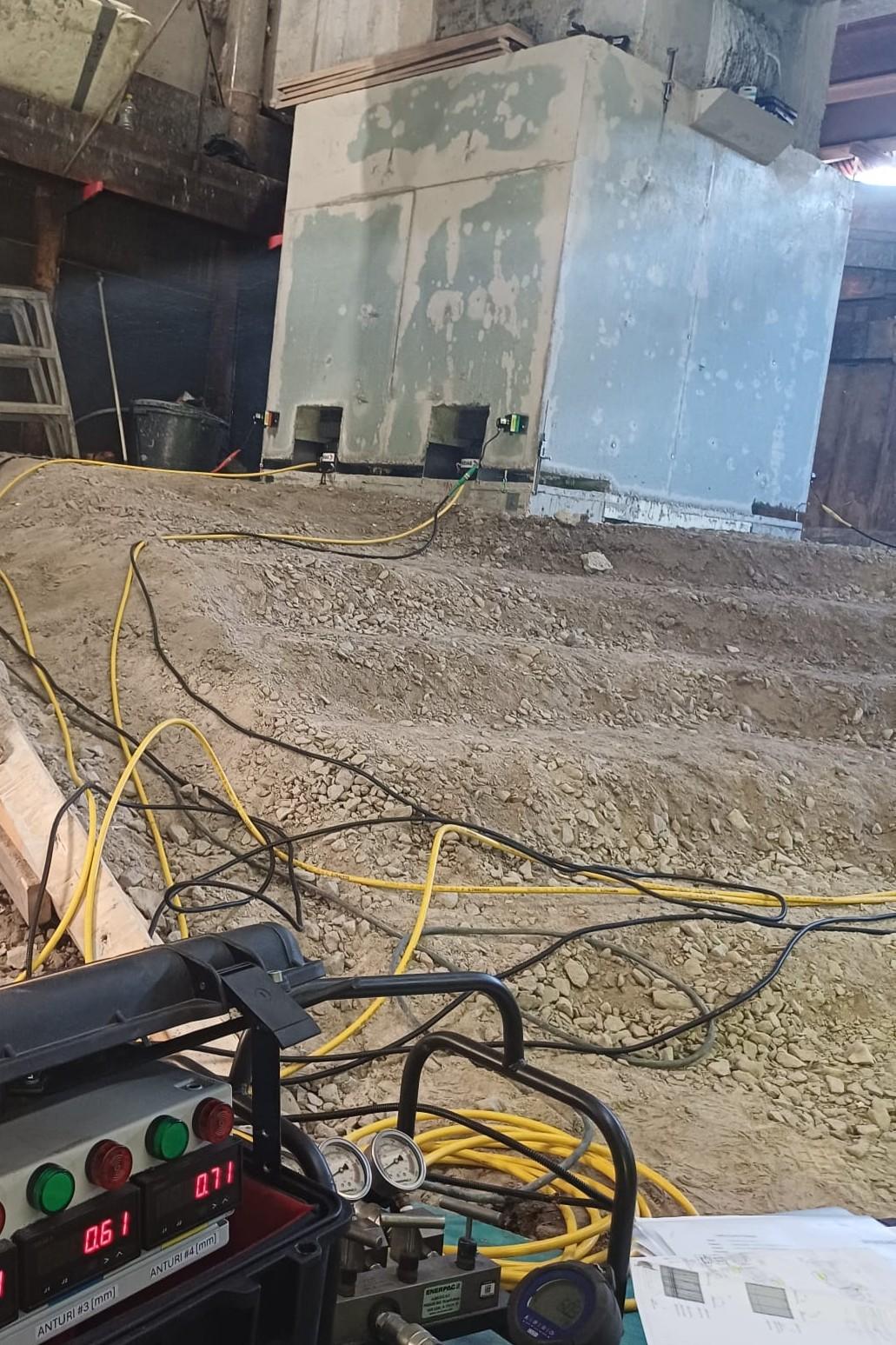
The progress of the jacking operation is monitored with an accuracy of hundredths of a millimetre.
High Forces, Tight Tolerances
The jacking operation is an interesting combination of different methods. Similar load-transfer works are occasionally carried out as part of infrastructure projects, but to the best of our knowledge, a project of this kind beneath Dixi has never been undertaken before. The hydraulic equipment required for the operation is more commonly used on bridge construction sites. Bilal Atiye of Destia, who is responsible for this phase of the project, explains:
“In a situation like this, there are not many alternative ways of carrying out the work. Sitowise has done an excellent job with the design, and the execution has gone very smoothly. Detailed plans are especially important because, throughout the operation, we monitor with accuracy measured in fractions of a millimetre to ensure that the jacking progresses as planned and that the building remains completely stationary.”
Dedicated recesses have been cast into the support beams for the hydraulic jacks. A single jack has a maximum capacity of approximately 200 tonnes, and several jacks are installed on each support beam. The largest beams accommodate up to ten jacks.
“However, we use only a fraction of their full capacity. On this particular beam, we used four jacks and achieved the desired result with a combined jacking force of approximately 100 tonnes, even though four jacks could theoretically generate around 800 tonnes of force. We monitor the progress of the work and its effects with accuracy measured in fractions of a millimetre, and adjust the force as required,” says Bilal Atiye of Destia.
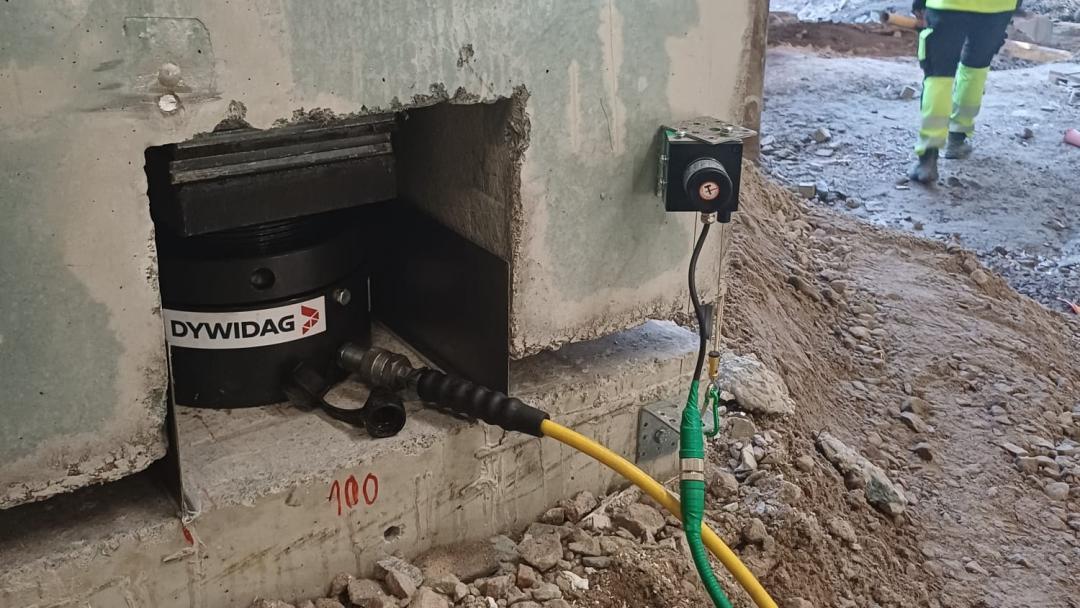
The jacks are installed in recesses cast specifically for them.
During the Jacking Operation, Part of the Building’s load is Transferred onto the New Piles.
The objective is to achieve approximately one millimetre of settlement in the new drilled piles and the jacking beam supported by them. This provides sufficient confirmation that the drill bit at the tip of the pile is firmly bearing against the bedrock and that part of the building’s load has been transferred onto the new piles. Once the target movement has been reached, the jacks are locked in position. The beam is then grouted using a high-strength grout with a compressive strength of 70 MPa. After the grout has cured, the jacks are removed and the jack recesses are filled using the same method.
The result is a building standing firmly on its new foundations, while the construction of the future Vantaa continues beneath it.
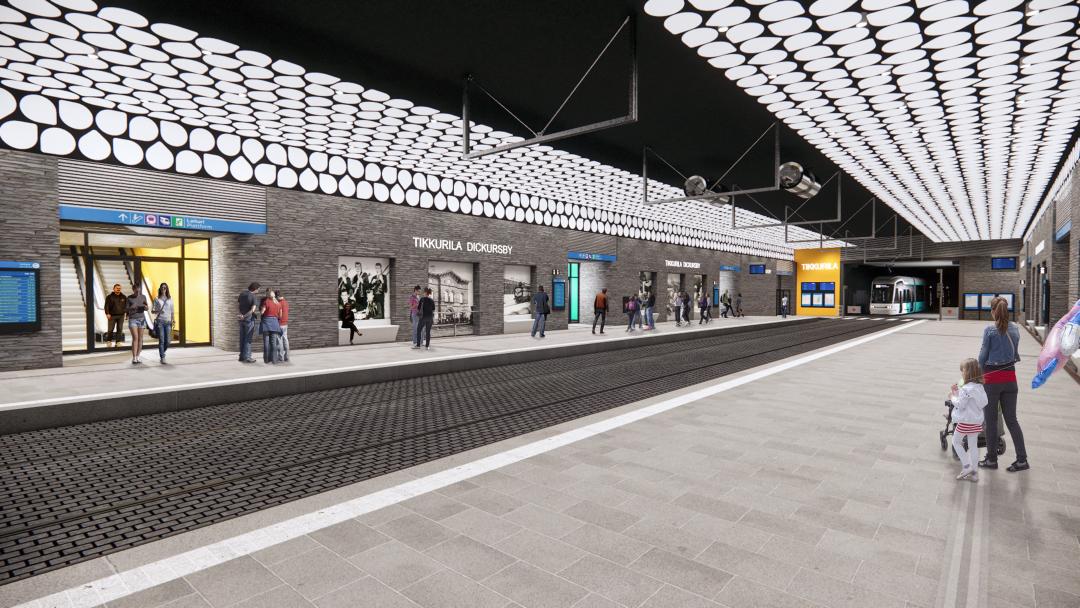
In the future, the light rail stop will be located beneath Tikkurila station and Dixi. It is expected to become the busiest stop on the entire light rail line.


